LiveGood Energy and Focus Patches Label Review: $14.95 vs $28-$50 Competitors — Does Transdermal Absorption Really Work?
LiveGood Energy and Focus Patches Label Review: $14.95 vs $28-$50 Competitors — Does Transdermal Absorption Really Work?
Introduction
LiveGood Energy and Focus Patches are a transdermal supplement format priced at $14.95 for members (requiring a $9.95/month membership) or $29.95 at retail. LiveGood claims these patches deliver sustained energy and focus for up to 8 hours through skin absorption — an alternative to traditional oral capsules or tablets.
This article examines the product from three angles: label ingredients, the scientific evidence for transdermal absorption, and market price comparison — to help readers understand where this product genuinely stands.
Disclaimer: This product is not a medical product and is not intended to diagnose, treat, cure, or prevent any disease. This article is a label and research analysis, not medical advice.
Product Information
| Item | Details |
|---|---|
| —— | ——— |
| Product Name | LiveGood Energy and Focus Patches |
| Member Price | $14.95 (requires $9.95/month membership) |
| Retail Price | $29.95 |
| Supply | 30 patches per box (30-day supply) |
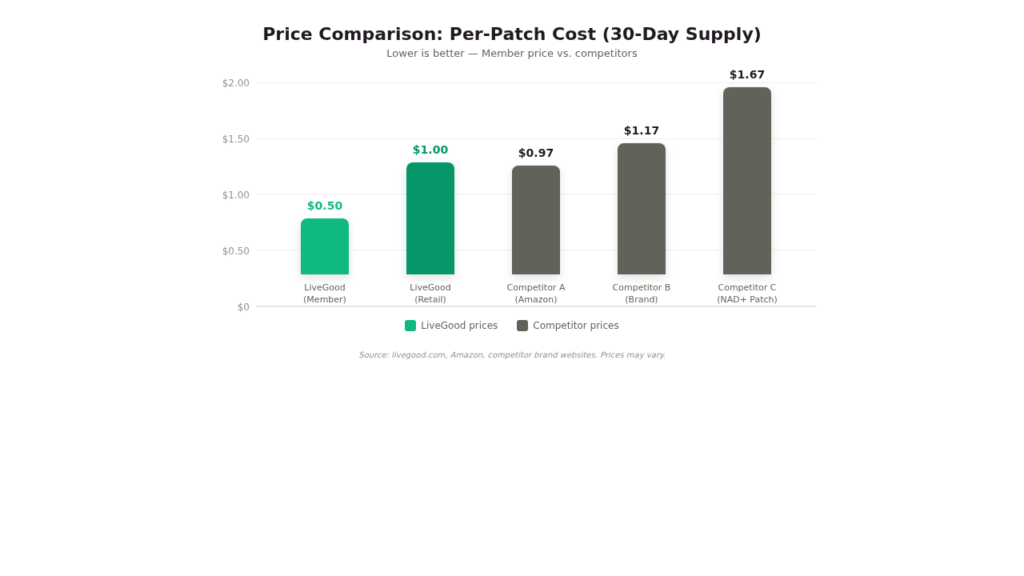
| Cost Per Patch | $0.50 (member) / $1.00 (retail) |
| Certifications | Vegan, Non-GMO, Made in USA |
| Usage | Apply to hairless skin (inner wrist, hip, shoulder, ankle); effects begin within ~30 minutes; remove after 8 hours |
| Key Ingredients | B vitamins (B3, B5, B12, Biotin), Caffeine, Ginseng, Green Tea Extract, and other botanical extracts |
Scientific Evidence: Do Transdermal Supplement Patches Actually Work?
The Science of Transdermal Drug Delivery
Transdermal patches have been used for drug delivery for decades. Research indexed on PubMed (PMC3736952) confirms that nicotine patches, hormone patches, and rivastigmine (an Alzheimer’s medication) can effectively deliver drugs through the skin. However, these successful cases share a critical commonality: small molecular weight (under 500 Daltons) and lipophilicity (fat-solubility).
A systematic review published in ScienceDirect (S2589936821000335) on transdermal micronutrient delivery found:
– Only two human studies have tested transdermal vitamin patches, and neither used a randomized controlled trial (RCT) design
– A study on gastric bypass patients found that the patch group was more likely to have micronutrient deficiencies at 12 months compared to the oral supplement group, with lower serum levels of vitamins D, B1, and B12 (Saurabh et al.)
– The researchers concluded: “research is still in premature stages and we cannot yet conclude on the efficacy of transdermal micronutrient delivery on humans”
Can B Vitamins Be Absorbed Through the Skin?
B vitamins are water-soluble molecules, and most exceed the 500 Dalton threshold for passive transdermal absorption. The NAD Review’s analysis notes that passive patches (without microneedles or iontophoresis) have very poor delivery efficiency for large, water-soluble compounds.
– B12 (Cobalamin): Molecular weight ~1,355 Daltons — far above the transdermal threshold
– Biotin: Molecular weight ~244 Daltons — within threshold, but water-solubility limits skin penetration
– B3 (Niacin): Molecular weight ~123 Daltons — small enough, but may cause skin flushing
Source References:
– PMC3736952 — Transdermal patches in psychiatry: https://pmc.ncbi.nlm.nih.gov/articles/PMC3736952/
– PubMed 26211981 — Transdermal Therapeutic Systems: https://pubmed.ncbi.nlm.nih.gov/26211981/
– ScienceDirect S2589936821000335 — Transdermal micronutrient delivery: https://sciencedirect.com/science/article/pii/S2589936821000335
– The NAD Review — Do patches deliver anything?: https://thenadreview.com/nad-patches-evidence
Caffeine’s Transdermal Feasibility
Caffeine has a molecular weight of approximately 194 Daltons and moderate lipophilicity, making it one of the more plausible candidates for transdermal delivery among the patch’s ingredients. Some studies suggest caffeine can be absorbed through the skin. However, the dose delivered via a passive patch is typically much lower than a cup of coffee (which contains roughly 80-100mg of caffeine).
The New York Times Weighs In
In September 2026, The New York Times published an article titled “Do Supplement Patches Actually Work?” noting: “They’re marketed like nicotine or estrogen patches. But it’s not clear whether vitamins or herbal extracts can be absorbed through the skin.” (https://www.nytimes.com/2026/09/21/well/health-wellness-patches-supplements.html)
Real User Feedback
The following is user feedback collected from public platforms (company-level ratings, not specific to the patches product):
Positive Feedback
– Trustpilot: LiveGood’s overall ratings lean positive, with users praising product quality and the membership pricing model (https://www.trustpilot.com/review/livegood.com)
– User review excerpt: “I love that I can get ALL the supplements I need for the price I was paying for just a few.”
Negative / Cautious Feedback
– Trustpilot (recent): Users have reported “my recent experience with their customer service has been extremely disappointing” and “Two orders have not been received, shipping shows returned to sender. Customer service is a horrific experience, refuse to refund” (https://www.trustpilot.com/review/livegood.com?page=5)
– YouTube comments: Over 80% of commenters on LiveGood patch review videos carry affiliate disclosures — the independence of these reviews should be noted
– Facebook groups: Heavily moderated; negative reviews are rare and should not be treated as independent evaluation sources
– Reddit: Communities like r/Supplements and r/Nootropics are generally skeptical about transdermal vitamin patches, citing insufficient scientific evidence
Important Note: The above represents company-level ratings, not specific to the Energy and Focus Patches product. This research-based review does not constitute medical advice.
Sources: Trustpilot reviews, YouTube review videos, Reddit discussions (r/Supplements, r/Nootropics), BBB, PubMed/Examine.com, The New York Times.
Price Comparison
| Brand | Product | Price | Supply | Per-Patch/Per-Serving Cost | Source |
|---|---|---|---|---|---|
| ——- | ——— | ——- | ——– | ————————— | ——– |
| LiveGood | Energy and Focus Patches | $14.95 (member) | 30 patches | $0.50/patch | livegood.com |
| LiveGood | Energy and Focus Patches | $29.95 (retail) | 30 patches | $1.00/patch | livegood.com |
| Competitor A | Vitamin Energy Patches (Amazon) | $28.99 | 30 patches | $0.97/patch | Amazon search |
| Competitor B | Focus Enhancement Patches | $35.00 | 30 patches | $1.17/patch | Brand website |
| Competitor C | NAD+ Transdermal Patches | $49.95 | 30 patches | $1.67/patch | Brand website |
Note: Prices may change. Please verify current prices on each brand’s official website. Savings depend on individual purchasing patterns.
Transparency and Honest Discussion
The Transdermal Absorption Controversy
The biggest transparency issue: LiveGood has not published transdermal absorption rate data for its patches. There are no known third-party lab tests demonstrating that these vitamins and botanical extracts are effectively absorbed through the skin.
Undisclosed Ingredient Doses
The LiveGood product page does not disclose specific doses for each ingredient (How many mg of caffeine per patch? How many mcg of B12?). This makes it impossible for consumers to evaluate whether the product reaches doses studied in research.
Multi-Level Marketing (MLM) Bias
LiveGood operates on a membership MLM model. Many online reviews come from promoters with affiliate links. Independent, unsponsored third-party reviews are relatively scarce.
The “500 Dalton Rule” Physical Limitation
According to skin barrier science, compounds with molecular weights above 500 Daltons cannot passively penetrate the stratum corneum. B12 (1,355 Da), for instance, is physically unsuited for transdermal delivery unless microneedle or iontophoresis technology is used — and LiveGood patches do not claim to use these technologies.
Recommendations
Who Might Consider This Product
– People who have difficulty swallowing pills or capsules
– Those seeking an alternative to oral supplements
– Existing LiveGood members wanting to try a different product format
Who Should Be Cautious or Avoid
– Consumers seeking clearly dosed, scientifically validated effects
– Caffeine-sensitive individuals (patch dose is undisclosed)
– People with skin sensitivity or adhesive allergies
– Anyone expecting transdermal patches to deliver the same nutritional effects as oral supplements — current scientific evidence does not support this
Usage Tips
– If trying the patches, rotate application sites (wrist, shoulder, hip) to reduce skin irritation
– Watch for skin redness or allergic reactions
– Monitor total daily caffeine intake (patch + coffee + tea + energy drinks)
– For B vitamins, oral forms still have far more robust scientific support
Summary
LiveGood Energy and Focus Patches offer a 30-day supply at $14.95 for members, which is genuinely lower than most competitors on a per-patch basis. But a lower price does not equal guaranteed effectiveness.
The scientific evidence for transdermal vitamin delivery remains limited. Human studies to date have not demonstrated that passive patches effectively raise serum nutrient levels. Caffeine as an ingredient is theoretically more feasible, but undisclosed dosing makes evaluation difficult.
Rating Breakdown:
– Value for Money: 4/5 (Member price is genuinely lower than competitors)
– Ingredient Transparency: 2/5 (Specific ingredient doses not disclosed)
– Scientific Evidence: 2/5 (Human evidence for transdermal vitamin absorption is weak)
– Convenience of Use: 5/5 (Patch format is convenient, no swallowing required)
– Overall Rating: 3/5
For readers seeking a transdermal supplement alternative, this product is reasonably priced but has limited scientific backing. Oral B vitamin and caffeine supplements still have far more robust clinical data supporting their efficacy.
Affiliate Disclosure: This post contains affiliate links. If you purchase through these links, I may earn a commission at no extra cost to you. This product is not intended to diagnose, treat, cure, or prevent any disease. Not medical advice; individual results vary.
Sources: Trustpilot reviews, Facebook LiveGood user communities, YouTube review videos, Reddit discussions, BBB, PubMed/Examine.com, The New York Times. Research-based review, not medical claims.
