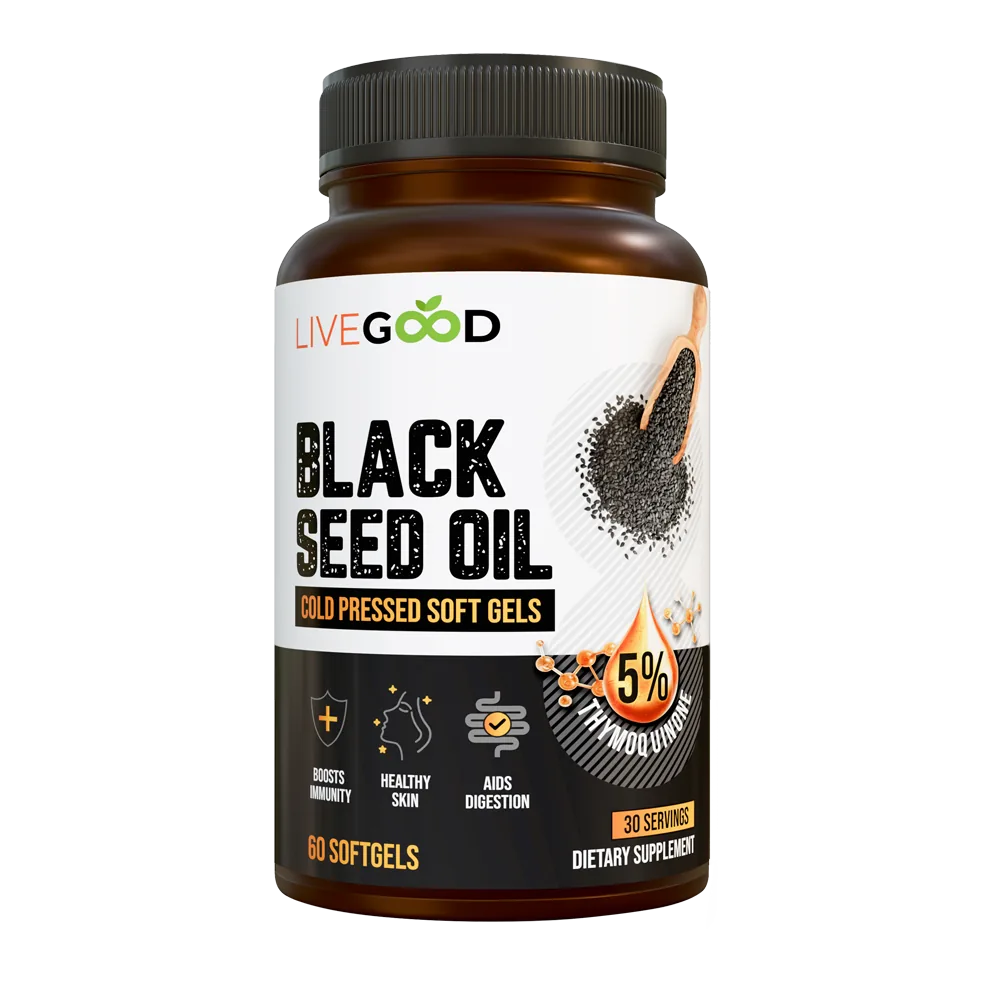
LiveGood Black Seed Oil Label Review: 1,000 mg Cold-Pressed Oil with 5% Thymoquinone — What to Know Before You Buy
Disclaimer: This post shares product label information and public sources. It is not medical advice. This product is not intended to diagnose, treat, cure, or prevent any disease. Individual results vary.
What is LiveGood Black Seed Oil?
LiveGood Black Seed Oil is a softgel supplement made from cold-pressed black cumin seed oil (Nigella sativa). The label says the oil is standardized to 5% thymoquinone, a compound found in black seed that researchers often study.
I have not used this product myself. This post is a label-first look: what is in the bottle, what it costs, what reviews of the research say in general, and what to check before you buy.
What the Supplement Facts label says
- Serving size: 2 softgels
- Servings per container: 30 (60 softgels)
- Per serving: Black Cumin Seed Oil (Nigella sativa) 1,000 mg, standardized to 5% thymoquinone
- Other ingredients: gelatin, glycerin, purified water
- Label icons: soy free, non-GMO, gluten free, dairy free, made in a GMP-compliant facility
- Directions (product page): take two capsules daily with a glass of water, best taken with food
One simple math note: 5% of 1,000 mg works out to about 50 mg of thymoquinone per serving, based on the label’s own numbers. The softgels contain gelatin, so they are not a vegetarian product.
Price check
On the LiveGood shop at the time of writing, Black Seed Oil is listed at USD 14.95 for members and USD 34.95 at retail. At the member price, that is about USD 0.50 per daily serving (USD 14.95 ÷ 30 servings). Prices can change, so check the current price before you order.
Keep in mind that the member price requires a LiveGood membership, which has its own monthly fee. If you only want one or two products, add that fee to your math.
What is thymoquinone, and why does the label show a percentage?
Black seed oil contains many natural compounds. Thymoquinone is the one that shows up most often in research papers about Nigella sativa. Because the amount can vary from one oil to another, some brands list a “standardized” percentage so buyers can compare.
LiveGood’s product page says many black seed oils on the market contain much less thymoquinone. We could not check other brands’ lab results for this post, so treat that as the company’s own comparison.
What research reviews say in general
A 2013 review in the Asian Pacific Journal of Tropical Biomedicine summarized the traditional uses of Nigella sativa, its chemical makeup and the lab and animal studies done up to that time (Ahmad et al., 2013; DOI 10.1016/S2221-1691(13)60075-1).
A 2017 review in the Journal of Pharmacopuncture collected clinical trials on black seed and thymoquinone in people (Tavakkoli et al., 2017; DOI 10.3831/KPI.2017.20.021). Reviews like this are useful to see what has been studied, how big the studies were and which questions are still open.
These papers looked at black seed in general, in many different forms and amounts. They did not test LiveGood Black Seed Oil, so they are background reading, not a promise about what this product will do.
A note about the marketing
The bottle and the product page use strong marketing words. Those are the company’s statements. In the U.S., the label itself notes that statements like these have not been evaluated by the FDA. We stick to the label facts and published sources here.
Things to check before you buy
- Medications and health conditions: Herbal oils can interact with some medicines. If you take any medication, are pregnant or nursing, or have a health condition, talk with your doctor or pharmacist first.
- Gelatin: The softgel shell is made with gelatin, which matters if you avoid animal products.
- Take it with food: The product page suggests taking it with food.
- Read your local label: Labels and formulas can change, so check the bottle you receive.
Bottom line
LiveGood Black Seed Oil is a simple formula: 1,000 mg of cold-pressed black cumin seed oil per two-softgel serving, labeled at 5% thymoquinone, with only gelatin, glycerin and water as other ingredients. At about USD 0.50 per day for members, the price is easy to compare with other brands. If you are curious, read the label, compare thymoquinone numbers, and check with a health professional first.
See LiveGood Black Seed Oil in the shop →
Sources
- LiveGood. Black Seed Oil product page and Supplement Facts label. livegood.com/blackSeedOil (accessed November 2, 2026).
- Ahmad A, Husain A, Mujeeb M, et al. A review on therapeutic potential of Nigella sativa: A miracle herb. Asian Pacific Journal of Tropical Biomedicine. 2013;3(5):337-352. DOI 10.1016/S2221-1691(13)60075-1
- Tavakkoli A, Mahdian V, Razavi BM, Hosseinzadeh H. Review on clinical trials of black seed (Nigella sativa) and its active constituent, thymoquinone. Journal of Pharmacopuncture. 2017;20(3):179-193. DOI 10.3831/KPI.2017.20.021
Affiliate disclosure: This post contains affiliate links. If you buy through them, Kevin Liu may earn a commission at no extra cost to you. We do not make income promises.
Medical disclaimer: This article is for general education only and is not medical advice. Supplements are not intended to diagnose, treat, cure, or prevent any disease. Talk with a qualified healthcare professional before starting any supplement, especially if you are pregnant, nursing, take medications, or have a medical condition. Individual results vary.
