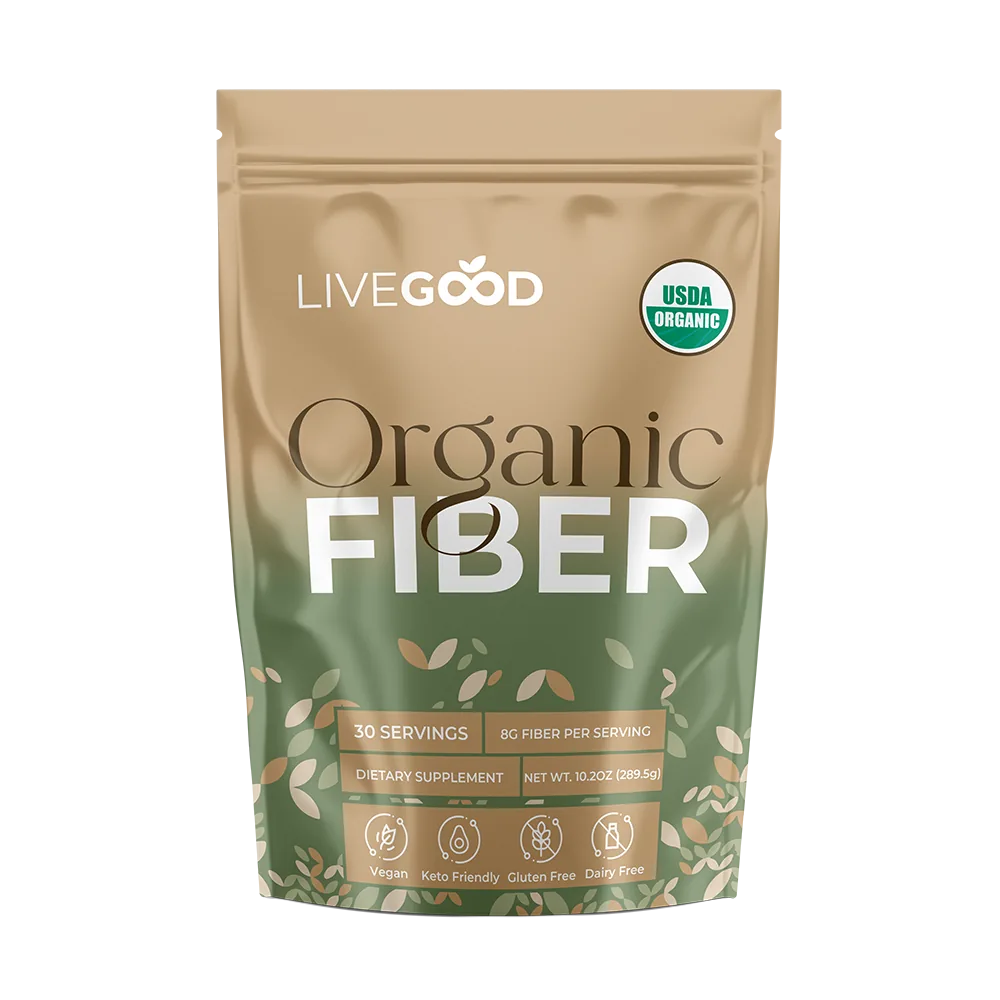
LiveGood Organic Fiber Label Review: 8 g of Fiber from 10 Organic Ingredients, Led by Agave Inulin
Disclaimer: This post is a label-first look based on the product page and public sources. It is not medical advice. This product is not intended to diagnose, treat, cure, or prevent any disease. Individual results vary.
What this post covers
LiveGood Organic Fiber is a powdered fiber blend that you mix into water, juice or a smoothie. This post looks at what the label lists, what one serving costs, what public sources say about fiber in general, and what to check before you buy. Kevin has not used this product himself, so this is a label review, not a personal experience post.
What the label says
From the supplement facts panel on LiveGood’s product page (checked November 4, 2026). One serving is 1 scoop (about 9.65 g), and each pouch has 30 servings (net weight 289.5 g).
| Item | Per serving |
|---|---|
| Calories | 35 |
| Total carbohydrate | 7 g (3% DV) |
| Dietary fiber | 8 g (29% DV) |
| Potassium | 25 mg (<2% DV) |
| Organic agave inulin powder (Agave tequilana) | 5,250 mg |
| Organic psyllium husk (Plantago ovata) | 1,500 mg |
| Organic pea fiber powder (Pisum sativum, whole pea) | 1,500 mg |
| Organic baobab powder (Adansonia digitata, fruit) | 375 mg |
| Organic chia seed powder (Salvia hispanica) | 375 mg |
| Organic apple cider vinegar powder (standardized to 5% acid) | 250 mg |
| Organic Ceylon cinnamon powder (bark) | 100 mg |
| Organic lemon fruit powder | 100 mg |
| Organic ginger root powder | 100 mg |
| Organic turmeric root powder | 100 mg |
- Label badges: USDA Organic, non-GMO, vegan, soy free and gluten free. The back of the pouch says it is certified organic by Global Organic Alliance and made in the USA.
- Directions (product page): add one scoop to 6 to 8 oz of water, juice or a smoothie and mix well. The page also suggests taking it with a full glass of water.
- Warning on the pouch: if you are pregnant, nursing, taking any medications or have a medical condition, consult your doctor before use.
The product page also makes several benefit claims. This post does not repeat them; it sticks to the label and public sources.
Reading the label’s own numbers
- Inulin is the main ingredient: 5,250 mg of agave inulin is a little more than half of the 9.65 g scoop. Psyllium and pea fiber add 1,500 mg each.
- The ten ingredients add up to the scoop: the listed amounts total 9,650 mg, which matches the 9.65 g serving size.
- The small ingredients are small: cinnamon, lemon, ginger and turmeric are 100 mg each, so think of them as flavor and blend details rather than meaningful amounts.
- One label detail to ask about: the panel lists 7 g of total carbohydrate but 8 g of dietary fiber. Fiber is normally counted inside total carbohydrate, so if this matters to you (for example, if you track carbs), it is worth asking LiveGood how the numbers were calculated.
- Daily Value: 8 g is listed as 29% of the Daily Value, which is based on 28 g of fiber for a 2,000-calorie diet.
Price check
On LiveGood’s product page (checked November 4, 2026), the member price is US$14.95 and the retail price shown in the page data is US$29.95. With 30 servings, that is about US$0.50 per serving at the member price and about US$1.00 at retail. The page compares it with Florasophy (US$38.50) and Thorne (US$42.00); that is the company’s own comparison, and we did not check those brands’ prices or formulas.
Keep in mind that the member price requires a LiveGood membership, which has its own monthly fee. If you only plan to buy one or two items, include that fee in your math. Prices can change and may differ by country.
What public sources say about fiber
Most people eat less fiber than recommended
The Dietary Guidelines for Americans, 2020–2025 state that more than 90 percent of women and 97 percent of men do not meet recommended intakes for dietary fiber. The guidelines suggest about 14 g of fiber per 1,000 calories, and they point to food first: vegetables, fruits, beans, peas, lentils and whole grains (DGA 2020–2025).
A large series of systematic reviews in The Lancet by Reynolds and colleagues looked at carbohydrate quality and fiber intake, mostly from food, and the authors suggested that people aim for at least 25 to 29 g of dietary fiber per day (Reynolds et al., 2019; DOI 10.1016/S0140-6736(18)31809-9). Most of that evidence comes from observational studies of whole foods, so it does not tell us how any specific supplement performs.
Not all fibers behave the same
McRorie and McKeown explain that the old “soluble versus insoluble” split does not tell the whole story. What matters more is how a fiber behaves in the gut: whether it forms a gel (viscosity) and whether gut bacteria ferment it. In their review, psyllium is described as a gel-forming fiber that is not readily fermented, while inulin is described as a soluble fiber that is readily fermented and does not form a gel. They also note that fermentation can come with gas (McRorie & McKeown, 2017; DOI 10.1016/j.jand.2016.09.021). Because this blend is mostly inulin, with psyllium and pea fiber in smaller amounts, it helps to know which type you are getting.
Things to check before you buy
- Go slowly: if you do not eat much fiber now, a sudden 8 g jump can feel like a lot. Many dietitians suggest adding fiber gradually and drinking enough water.
- Drink enough water: the product page itself says to take it with a full glass of water, which matters for psyllium-containing products.
- Medications: fiber supplements can affect how some medicines are absorbed. If you take any medication, ask your pharmacist how to space them.
- Health conditions: if you have a digestive condition, swallowing problems, or are pregnant or nursing, talk with your doctor first, as the pouch also advises.
- Food first: a supplement can help fill a gap, but the guidelines above point to whole foods as the main source of fiber.
- Read your own label: formulas and labels can change, so check the pouch you receive.
Bottom line
LiveGood Organic Fiber lists 8 g of fiber per 9.65 g scoop from ten organic ingredients, led by agave inulin (5,250 mg), with psyllium and pea fiber (1,500 mg each). It costs about US$0.50 per serving at the member price. Public sources agree that most people eat less fiber than recommended and that different fibers behave differently, so it is worth knowing what is in the scoop. If you are curious about other gut-related products, see the earlier LiveGood Probiotic Gut Support review.
See Organic Fiber in the LiveGood shop →
Sources
- LiveGood. Organic Fiber product page and supplement facts panel. shoplivegood.com/formosa (accessed November 4, 2026).
- U.S. Department of Agriculture and U.S. Department of Health and Human Services. Dietary Guidelines for Americans, 2020–2025. 9th Edition. December 2020. DietaryGuidelines.gov
- Reynolds A, Mann J, Cummings J, Winter N, Mete E, Te Morenga L. Carbohydrate quality and human health: a series of systematic reviews and meta-analyses. The Lancet. 2019;393(10170):434-445. DOI 10.1016/S0140-6736(18)31809-9
- McRorie JW, McKeown NM. Understanding the Physics of Functional Fibers in the Gastrointestinal Tract: An Evidence-Based Approach to Resolving Enduring Misconceptions about Insoluble and Soluble Fiber. Journal of the Academy of Nutrition and Dietetics. 2017;117(2):251-264. DOI 10.1016/j.jand.2016.09.021
Affiliate disclosure: This post contains affiliate links. If you buy through them, Kevin Liu may earn a commission at no extra cost to you. Kevin has not personally used this product. We do not make income promises.
Medical disclaimer: This article is for general education only and is not medical advice. Supplements are not intended to diagnose, treat, cure, or prevent any disease. Talk with a qualified healthcare professional before starting any supplement, especially if you are pregnant, nursing, take medications, or have a medical condition. Individual results vary.
